Carriage Oaks doesn't have an architectural review board. It doesn't have a gate, a covenant enforcement officer, or a fee schedule that runs into the thousands. The homeowners association charges somewhere between $150 and $200 a year, depending on which listing you're reading, and that money goes toward mowing common areas and putting on a neighborhood event or two. So why does a house in this northeast St. Joseph subdivision routinely list for twice what a typical house in the city sells for?
That gap is the whole story, and it's not the story you'd expect.
The Number That Doesn't Match the Rules
Across St. Joseph, the median sale price over the three months ending in June 2026 sat at $189,000, up 8.2 percent from the same stretch a year earlier. List prices citywide ran a bit higher, with a median around $214,000 as of August 2026. Either number puts the typical St. Joseph home somewhere in the low-to-mid $200,000s at most.
Carriage Oaks doesn't play in that range. Recent single-family listings in the subdivision have clustered between roughly $395,000 and $420,000, with an average list price closer to $409,000. That's not a modest premium. That's close to double what the rest of the city is paying, in a neighborhood with one of the lightest HOA structures in St. Joseph.
In subdivisions where the premium is steep, the money usually buys a governance layer: an association with real teeth, a design review process, restrictions on what you can park in your driveway or paint your shutters. Carriage Oaks charges less for its HOA than plenty of far cheaper neighborhoods in town. Whatever buyers are paying for here, it isn't rules.
Not New, Just Cared For
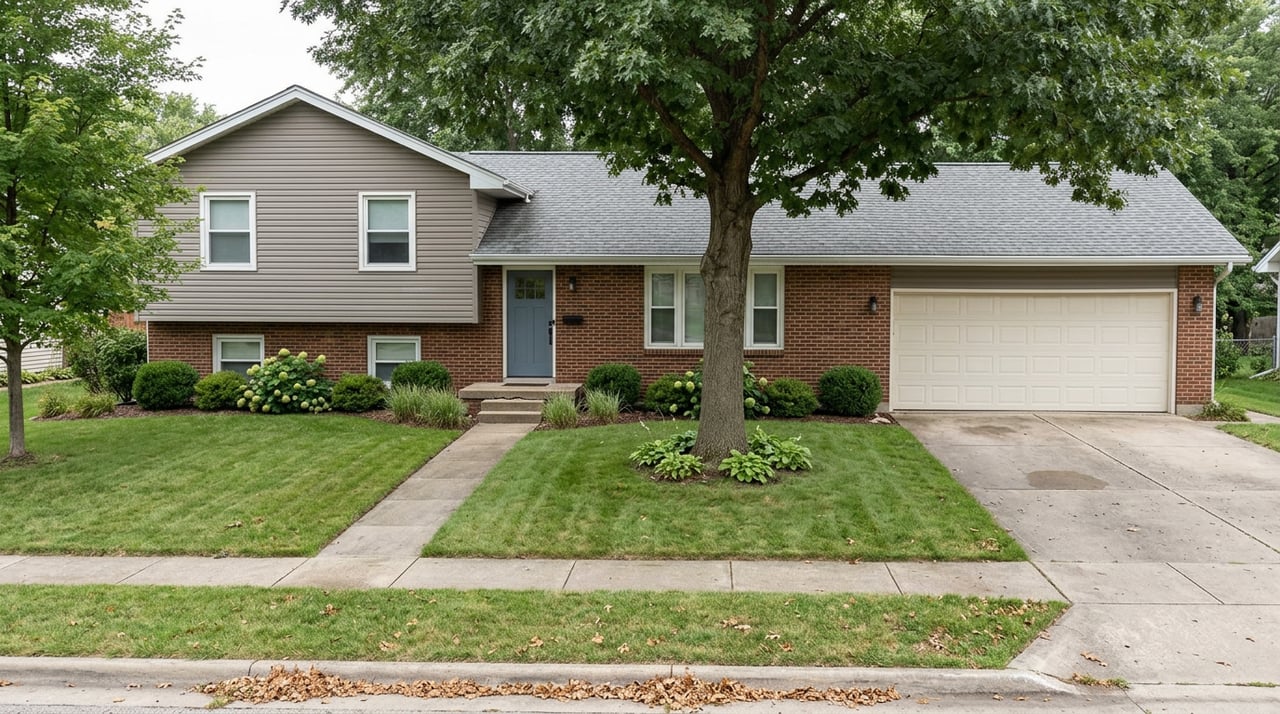
A recent listing on Kingston Court makes the pattern easy to see. The house is a raised ranch, more than 3,000 square feet, with 12-foot ceilings, real wood flooring, and a primary suite with a jet tub. It's also been retrofitted for full wheelchair accessibility: a zero-entry basement bath, a monolithic sidewalk from driveway to front door, and a lift built into the kitchen.
None of that reads like new construction, and the update history in the listing confirms it. The roof is new. The carpet in the primary bedroom is new. The garage door opener was installed in 2024. Trim and paint throughout the main living areas were finished the year before that. A water softener and water heater were replaced separately. Each item was addressed on its own timeline, not folded into one comprehensive renovation.
That's the pattern worth understanding before you write an offer here. Carriage Oaks is a well-established subdivision, and "well-established" means the roofs, water heaters, and HVAC systems are original to a build date that predates the current listing price by decades, even when the finishes look current. Fresh paint and a new garage opener tell you the seller has kept the house up. They don't tell you when the furnace was last serviced or how old the sewer lateral is. Ask for that history directly rather than reading it off the surface.
The tree canopy took forty years to grow. The garage opener took an afternoon to replace. A buyer needs to know which one they're actually paying for.
What the Premium Buys Instead of Governance
If it isn't restrictions, the premium in Carriage Oaks tracks to three things that show up consistently in how the neighborhood markets itself and how residents describe it: mature streetscape, walkable green space, and a housing stock built with more room than the typical St. Joseph lot allows.
The sidewalks and tree canopy aren't marketing language here. They're decades old, which is exactly what makes them valuable and exactly what a newer subdivision can't manufacture on a five-year build-out. Two named amenities anchor the recreational side of that value: Corby Pond, used for walking and valued for its scenery, and Hyde Park, which carries playgrounds, picnic areas, and sports facilities within easy reach of the subdivision. Neither is inside the Carriage Oaks HOA boundary in the way a private clubhouse would be, but both function as extensions of the neighborhood's daily life, and neither shows up in a citywide median.
The lot sizes and floor plans do the rest of the work. Raised ranch construction with 3,000-plus square feet, real wood floors, and gas fireplaces is common in recent Carriage Oaks listings, and that kind of square footage simply costs more to build and to buy than the smaller homes that make up a larger share of St. Joseph's overall housing stock. A $189,000 citywide median includes a lot of homes half this size. Comparing the two medians directly flattens a real difference in what you're purchasing.
What This Means at the Offer Stage
None of this means Carriage Oaks is overpriced for what it offers. It means the reasons for the price are structural and physical rather than regulatory, and that changes what you should verify before you make an offer.
- Ask directly for the age of major systems, not just the visible update list. A new garage opener and fresh trim tell you about the last two years. They don't tell you about the roof deck, the furnace, or the sewer lateral underneath the mature trees that make the street look the way it does.
- Confirm which HOA fee applies to the specific listing. Figures in recent Carriage Oaks listings have ranged from $150 to $200 annually, and what that fee covers can shift slightly from one property to the next.
- Walk the distance to Corby Pond and Hyde Park yourself before assuming proximity. Listings describe both as neighborhood amenities, but actual walking distance varies by which section of the subdivision a house sits in.
- Treat a raised ranch layout as a different inspection profile than a standard two-story. Split-level and raised ranch construction carries its own set of common issues around grading, drainage, and lower-level moisture that a general inspector should be asked about specifically.
A Couple of Questions Worth Asking Directly
Is the $150 to $200 HOA fee likely to increase? Fees that low typically fund basic common-area mowing and a neighborhood event or two, which means there's little cushion if a major shared expense comes up. Ask the seller or the association directly about the last few years of fee history before assuming it's fixed.
Does the price premium hold up at resale, or is it specific to right now? The gap between Carriage Oaks and the citywide median has been consistent enough to show up across multiple recent listings rather than a single outlier sale, which suggests it reflects the neighborhood's built character rather than a temporary swing in demand. Still, any buyer planning to sell within a few years should look at how quickly comparable Carriage Oaks homes have moved, not just their list price.
Carriage Oaks isn't charging you for permission. It's charging you for forty years of trees nobody can replant on demand, for a park and a pond that were already there when the subdivision filled in, and for square footage that costs real money to build regardless of what zip code it's in. Knowing that going in changes what you inspect, what you ask, and what you're actually comparing it to.
If you're weighing a move into Carriage Oaks or trying to figure out what a similar premium looks like in another St. Joseph neighborhood, Coder Haggard Lehr Real Estate Group can walk the comparison with you street by street. Start with a free, no-obligation look at what your current home could sell for and get your instant home valuation before you decide what to do next.