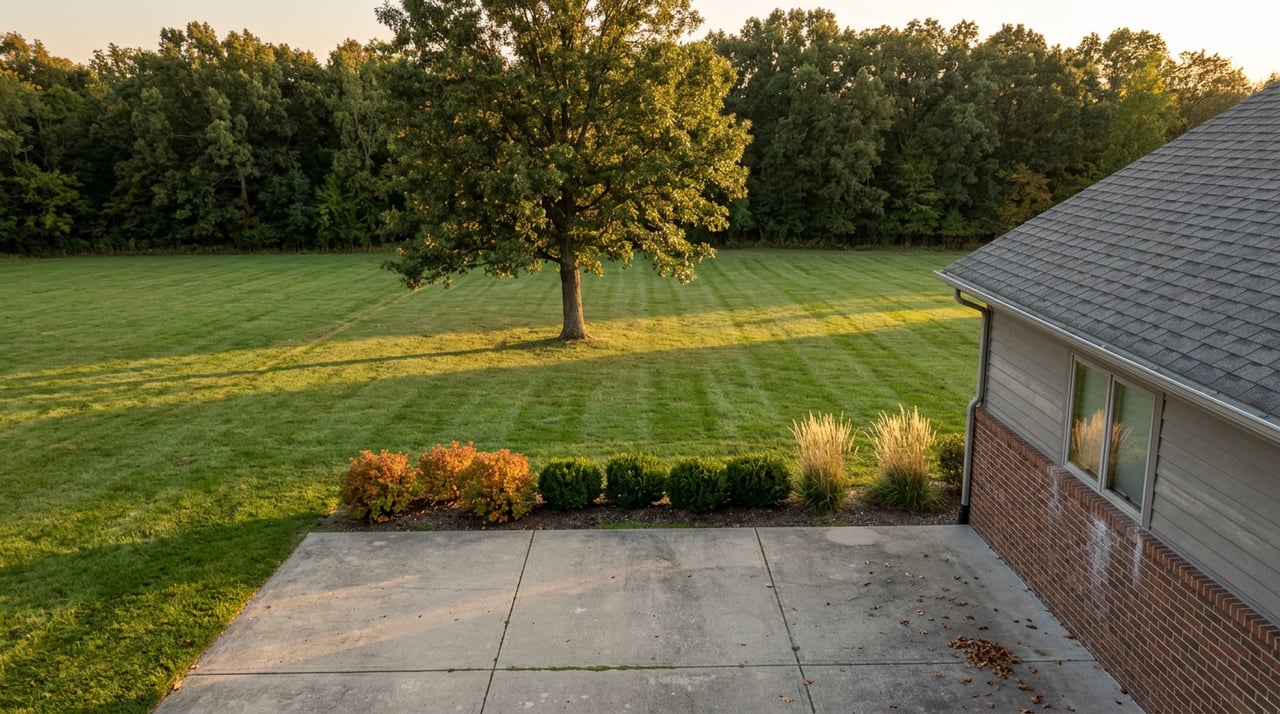
A recent listing for a four-bedroom home on Indian Ridge Road spelled out something the neighborhood's marketing copy never mentions. Road Responsibility: Public Maintenance. Water Source: PWS Dist. Sewer: Private Sewer, Septic Tank. HOA Fee: $450 a year, and the fee description reads "Includes: Street."
Read that last line twice. The county already maintains the road. The homeowners association bills separately for something labeled street anyway. That is not a contradiction buried in fine print. It is the entire logic of what Indian Ridge is selling, and it is worth understanding before you compare its price tag to a home three miles south inside St. Joseph city limits.
Indian Ridge markets itself as the best of both worlds, country living paired with city convenience, 40-plus acres of common ground and two ponds a few minutes from the North Shoppes. That pitch is accurate. What it does not say is that living outside city limits does not remove your utility and maintenance bills. It reroutes them through different providers, with different billing logic, and different failure modes than the ones you'd deal with on a city sewer and water line. The premium you pay for Indian Ridge is not just paying for acreage and a quieter street. It is paying for a different infrastructure system entirely, and that system has costs the city median price comparison never captures.
What "Outside City Limits" Actually Swaps Out
Inside St. Joseph, a home's monthly costs run through a short, familiar list: a city water bill, a city sewer bill, and municipal road maintenance funded through property taxes you already expect to pay. Indian Ridge trades every one of those for something structurally different.
Water comes from a public water supply district rather than the city utility department. Andrew County runs several of these districts, each a member-governed rural water system with its own board, its own infrastructure, and its own rate decisions. Sewer service does not exist at all in the traditional sense. Homes here run on private septic systems, which means wastewater treatment is the homeowner's equipment, the homeowner's maintenance schedule, and the homeowner's repair bill when something fails. Road maintenance, as the listing above shows, is handled by the public system, but that does not eliminate the HOA line item for street-related costs. It just means you are paying twice into two different pots for two different pieces of the same word.
None of this is a defect. Plenty of buyers specifically want to be off a shared city sewer main. But it does mean the sticker price on an Indian Ridge listing is not doing the same job as the sticker price on a city lot. One number reflects square footage and finishes. The other reflects square footage, finishes, and a private utility architecture layered underneath.
A city water bill and a septic tank are not two versions of the same expense. One is a monthly line item you can predict. The other is a maintenance obligation that costs nothing until it costs thousands.
The Septic Question Nobody Asks Until Inspection Week
Missouri is a caveat emptor state. Sellers have no legal obligation to have their home inspected before listing it, and the state does not mandate a septic inspection as a condition of closing. That surprises a lot of buyers moving from cities with sewer connections, because it means the burden of finding out whether a septic system works sits almost entirely with the buyer, not the transaction process itself.
In practice, lenders fill part of that gap. FHA and VA loans in particular tend to require a well and septic inspection before approval, even though the state does not. Combined well and septic inspections in Missouri typically run $400 to $650, done separately they land closer to $250 to $450 for the well and $300 to $550 for the septic side. That is a manageable line item during a normal transaction. The number that actually matters is what happens if the system fails the inspection. A full septic system replacement in Missouri can run anywhere from $5,000 to $25,000 depending on soil conditions and system type, and that is not a cost split evenly across a neighborhood. It is a cost that lands entirely on whoever owns the lot when the drain field finally gives out.
For a buyer comparing an Indian Ridge listing to a comparable city home, this is the number the median price comparison misses completely. A city home's sewer connection is invisible because it works quietly in the background for decades. A septic system is invisible for exactly the same reason, right up until an inspector uncovers the tank and finds a problem the seller never had to disclose.
The Water District Nobody's Heard Of, Voting on Money You'll Eventually Pay
Rural water in this part of Missouri runs through Public Water Supply Districts, member-governed systems distinct from anything the city of St. Joseph operates. Andrew County has several, each covering a different service area, each with its own board and its own capital needs.
One of them, Public Water Supply District #2 of Andrew County, based in Cosby, put a $15 million waterworks system revenue bond to a vote on April 7, 2026, aimed at systemwide repairs and extending service. That vote is not trivia. It is a preview of how infrastructure funding works out here compared to inside city limits. A city resident's water infrastructure is funded through a much larger municipal tax base and rate pool. A rural water district's infrastructure is funded by a much smaller group of member households voting on bonds that directly affect their own future rates. When a rural district needs $15 million in repairs, the households on that system feel it more directly than a city resident would feel an equivalent municipal project.
This does not mean Indian Ridge's water district is in worse shape than the city's. It means the financial exposure works differently, and a buyer evaluating the neighborhood should know that their water bill is tied to a much smaller, more locally governed system than the one serving in-city buyers.
The Price Gap You're Actually Comparing
As of August 2026, homes listed for sale across St. Joseph carried a median list price of $215,000. The most recent sold-price read for the broader market, from December 2025, put the median sale price at $170,000, up 13.3 percent year over year. Those two numbers measure different things, one is what sellers are asking, the other is what buyers are actually paying, and the gap between them tells you there is real negotiating room in the city market right now.
Against that backdrop, an Indian Ridge listing priced at $479,900 looks like it is competing in a different category entirely, and it is. That price reflects a larger lot, acreage-style setbacks, and access to the subdivision's private common ground and two ponds. But part of that gap is also the cost of the infrastructure difference described above. A buyer paying that premium is not simply buying more house. They are buying a private well-and-septic-style utility setup that shifts long-term maintenance risk onto them personally, in exchange for the acreage and privacy that a tighter city lot cannot offer.
The School Pipeline Buyers Often Miss
Indian Ridge sits in the Avenue City School District for elementary and middle school, but current listings show the high school pipeline runs through Savannah. That split is worth knowing before you assume a single district handles a child's entire K-12 path, since it affects everything from bus routing to which community your teenager eventually spends their school days in. It is a logistics fact, not a ranking, and it is easy to miss if you are only skimming a listing description rather than checking district assignment directly.
What This Means at the Offer Stage
If you are seriously comparing an Indian Ridge listing against an in-city alternative, a few practical steps change how you read the numbers:
- Ask for the septic system's inspection and pumping history before you write an offer, not after. A system with documented maintenance is a different risk profile than one with no records at all.
- Confirm which water district actually serves the specific address, since Andrew County has more than one, and ask about recent or pending rate changes tied to capital projects like the PWSD #2 bond vote.
- Get the exact HOA fee and what it covers in writing. "Includes: Street" can mean lighting, signage, or snow removal depending on the section of the subdivision, and it is worth knowing which before you budget around it.
- Separate the acreage premium from the infrastructure premium in your own head. One buys you space. The other buys you responsibility for systems a city buyer never has to think about.
A Few Questions Worth Asking Directly
Does every home in Indian Ridge have the same HOA fee? Not necessarily. The subdivision has multiple sections, and fee amounts can differ by phase, so confirm the number tied to the specific address rather than assuming a neighborhood-wide rate.
Is a septic inspection legally required to close? No, Missouri does not mandate one statewide, but many lenders, especially for FHA and VA loans, require it as a condition of financing.
Does the county road maintenance mean the HOA doesn't need to collect for streets? Not automatically. The listing detail above shows a home with publicly maintained roads still carrying an HOA fee that includes a street line item, so the two are not mutually exclusive.
If you're weighing an Indian Ridge address against something inside St. Joseph proper, the honest comparison isn't list price against list price. It's infrastructure against infrastructure, and that's a conversation worth having with someone who already knows which water district serves which road and what a recent septic inspection actually turned up. Brycen Haggard and the CHL team walk buyers through exactly that kind of comparison every week. Request a home valuation or reach out to talk through what a specific Indian Ridge address would actually cost you to own, not just to buy.